

The WEF Global Risks Report 2025: Predictions vs Reality
The WEF Saw the Risks. 2025 Delivered Them Faster.

Every January, the World Economic Forum releases a risk map that tries to describe the world without naming the actors who break it. The 2025 edition came out in mid-January. By the end of the year, the world had already delivered enough chaos for a full forensic comparison. The WEF Global Risks Report 2025 is one of the most sophisticated risk documents produced anywhere. It condenses thousands of expert inputs, cross-sector data and scenario modelling into a single map of global fragility. After reading it fully, it is clear the report deserves more credit than it often gets. It is rigorous, dense and far better grounded than most annual forecasts.
This audit is not an attempt to outrank the report. It is simply a comparison, an exercise in reading the world of 2025 as it unfolded and checking where the WEF predictions aligned with reality, where they were conservative, and where events moved faster than any model could anticipate. It is an analysis, not a verdict.
Link to the document released in Jan 2025 by WEF.
We picked the top nine issues for this audit. This is the TEAM IB assessment. Ten months of global events versus WEF predictions. The goal is simple: check whether the world matched the report or outran it.
1. War and Geopolitics
WEF Prediction:
State-based armed conflict ranked as the number one near-term global risk.
2025 Reality:
The WEF predicted conflict. It did not predict the speed or scale. Syria’s regime collapse pulled multiple regional actors into a vacuum. India and Pakistan collided briefly in May before a ceasefire froze the line. The US–India strategic partnership effectively evaporated under a tariff war that escalated to 50 percent duties. The longest US Government Shutdown in history weakened American credibility and accelerated multipolar drift.
2025 was not fragmented. It was leaderless.
TEAM IB Rating: 9.5/10
2. Climate and Extreme Weather
WEF Prediction:
Extreme weather was a high-ranked short-term and long-term risk. Climate instability was the defining threat of the decade.
2025 Reality:
Direct hit.
Globally, temperatures broke records again. Europe and Asia saw sudden, intense flood clusters that destroyed infrastructure and displaced hundreds of thousands. India recorded extreme weather on 99 percent of days in the first nine months. February was the warmest in 124 years.
Adaptation is losing to acceleration.
TEAM IB Rating: 10/10
3. Information Warfare and Misinformation
WEF Prediction:
Misinformation was the number one short-term global risk.
2025 Reality:
The distinction between truth and content collapsed in real time. Indonesia saw protests partly triggered by an AI-generated hoax video involving lawmakers. Deepfake scams became routine corporate threats. Small-scale fraud went synthetic, including an Airbnb host using a deepfake clip to claim property damage.
Information warfare remained embedded in existing conflicts, from Israel–Hamas to Indo-Pak tensions and Russia–Ukraine.
This was no longer a background issue. It became a daily operating condition.
TEAM IB Rating: 8.5/10
4. Cybersecurity and AI Failures
WEF Prediction:
Cyber insecurity and harmful AI outcomes were major technological risks.
2025 Reality:
This section aged almost too well. AI hallucinations caused real harm, including a hospitalization after unsafe diet advice from a chatbot. Automated fast-food systems were forced offline after malicious overloads. Somalia’s e-Visa breach exposed tens of thousands of applicants. A Salesforce-linked breach hit more than 200 companies.
The tools are scaling faster than the safeguards.
TEAM IB Rating: 9/10
5. Global Economy and Growth Outlook
WEF Prediction:
Economic downturn had slipped down the rankings, though younger respondents still flagged it as a concern.
2025 Reality:
The WEF underestimated the fracture lines. The US Government Shutdown entered historic territory. India–US tariffs reached 50 percent, cutting Indian exports sharply. Global growth drifted toward 2.6 to 3.2 percent, but for manufacturing and export-dependent economies, it felt like a recession.
The soft-landing story did not survive 2025.
TEAM IB Rating: 7/10
6. Supply Chains and Critical Trade Routes
WEF Prediction:
Geoeconomic confrontation and supply-chain fragmentation were major risks.
2025 Reality:
Weaponization replaced disruption. China executed two rounds of Rare Earth export controls, squeezing EV and defense supply chains across the West. Europe scrambled for substitutes that do not exist at scale. The Red Sea and Black Sea remained high-risk trade corridors with rising insurance costs.
Supply chains became geopolitical leverage points.
TEAM IB Rating: 8.5/10
7. Food, Water and Resource Stress
WEF Prediction:
Natural resource shortages were a top long-term risk.
2025 Reality:
The pressure is fully active. More than 300 million people required humanitarian aid globally. Syria’s collapse and conflicts across Sudan and Gaza deepened famine pockets. India’s extreme weather destroyed nearly 9.5 million hectares of crops. Water scarcity worsened.
TEAM IB Rating: 7.5/10
8. Societal Polarisation and Rights
WEF Prediction:
Polarisation and governance breakdown were expected to intensify.
2025 Reality:
The prediction manifested across regions. Nepal’s Gen Z protests toppled leadership after a social media ban backfired. Indonesia saw violent unrest over housing subsidies and political nepotism. In the United States, polarisation turned institutional, visible in congressional paralysis and the record shutdown.
Governance did not collapse everywhere. But it stalled often.
TEAM IB Rating: 8.5/10
9. India’s Risk Map
WEF Prediction:
India was seen as a rising power vulnerable to climate stress, trade shocks and information risks.
2025 Reality:
India absorbed multiple shocks simultaneously. A border clash with Pakistan. A tariff war with the United States. Extreme weather that killed thousands. Heavy crop damage. Large-scale digital misinformation.
India’s rise continued, but the external pressures were relentless.
TEAM IB Rating: 9/10
Overall TEAM IB Assessment
Overall Rating: 8.6/10
The WEF correctly identified the core pressures shaping the world. What it missed was the velocity. The risks did not arrive slowly. They detonated. The timeline collapsed and theory became daily experience.
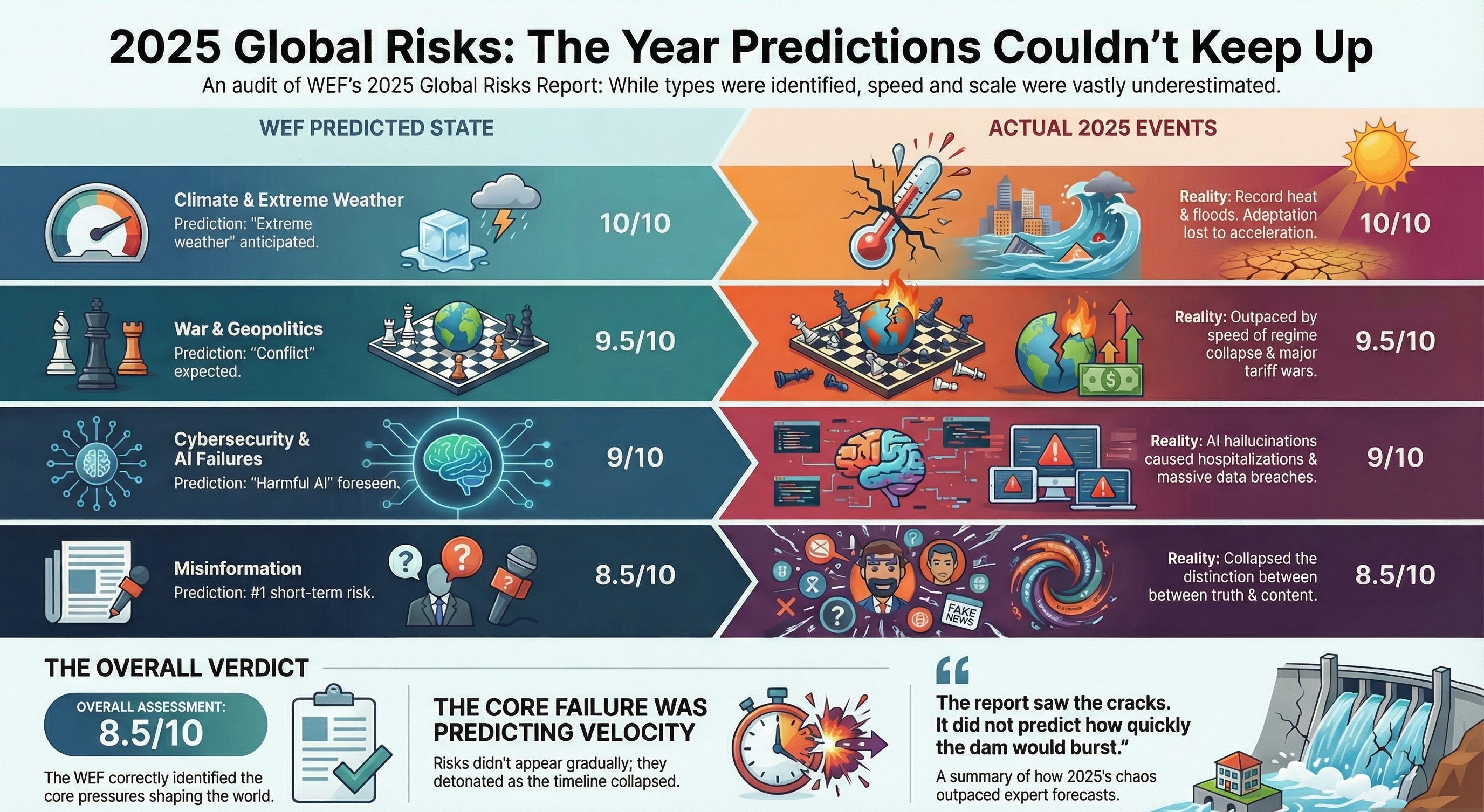
The report saw the cracks. It did not see how fast the dam would burst.
This analysis reflects independent TEAM IB assessment of 2025’s events. It is a study of predictions versus outcomes and does not intend to promote, attack or influence any institution, government or political actor.
Team IB — Understandable, Unfiltered & Unbiased.
Stay tuned and comment your thoughts on this, and view our previous posts in case you missed them.
🔗 Stay Connected
📌 Instagram: [Click to visit] → memes, quick takes & daily updates.
📌 Substack: You’re already here→ check our previous posts, in case you missed them.
📝 Note: This space is for analysis, not advocacy. We break things down so you can think, not follow a script