

The Bondi Beach Attack Was Local, Consequences Are Not
Beyond the incident: how Bondi reshapes security thinking, diplomacy, and narrative warfare.

On the evening of December 14, 2025, Bondi Beach in Sydney, one of Australia’s most open and symbolic public spaces, witnessed the country’s deadliest mass shooting in nearly three decades. What began as a public cultural gathering turned into a coordinated act of violence targeting civilians in a crowded, open setting.
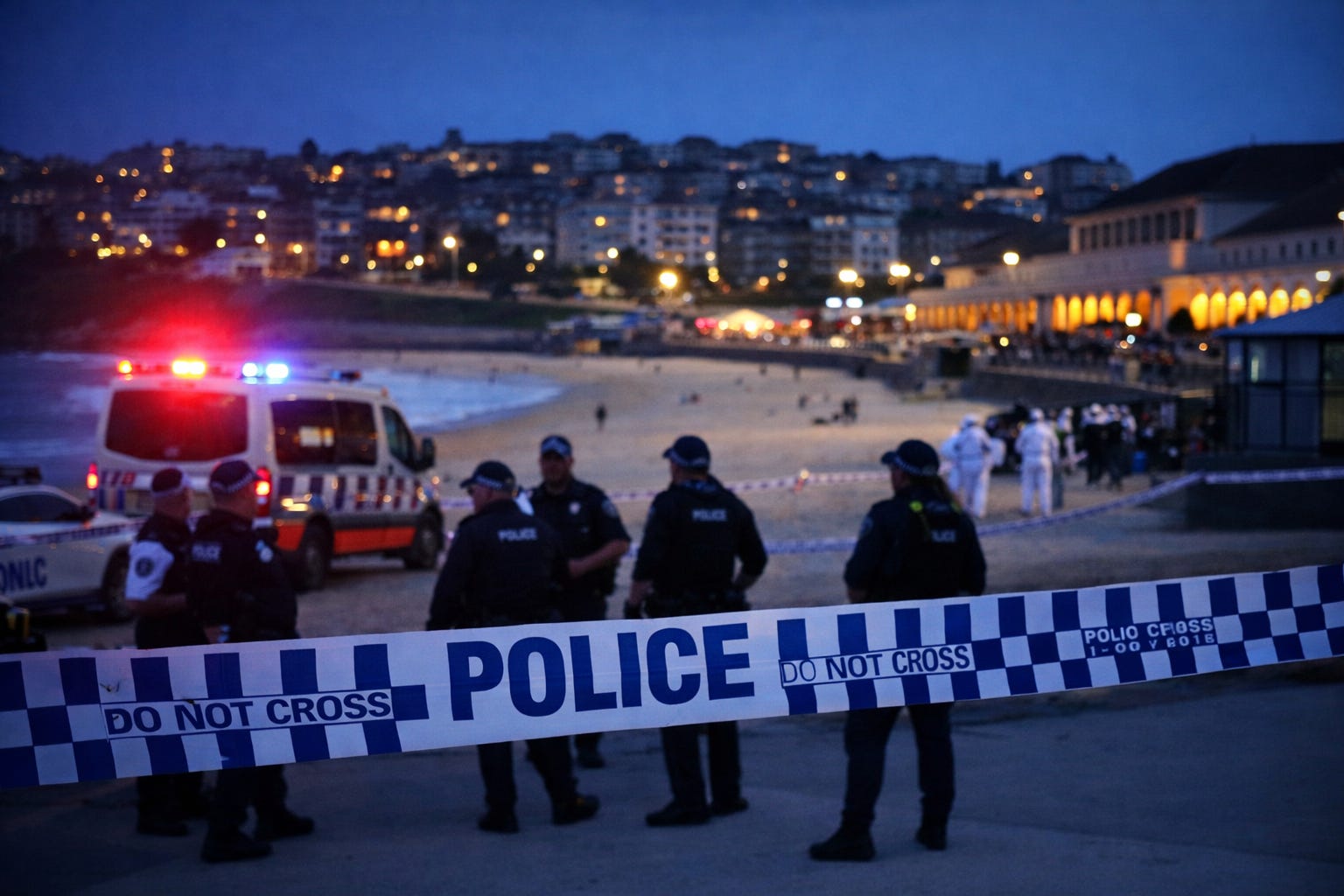
According to Australian authorities and Reuters reporting, two attackers opened fire from an elevated position overlooking a dense crowd, sustaining gunfire for several minutes before police intervened. The location, timing, and method suggest a deliberate choice of visibility and psychological impact rather than tactical gain.
At least 15 people were killed and more than 40 injured, including individuals across age groups. Australia has not experienced an attack of this scale since the Port Arthur massacre in 1996.
Security analysts have described the incident as “Hamas-style”, not as an organisational attribution, but as a reference to methodology: soft civilian targets, symbolic timing, public spectacle, and the intention to generate fear beyond the immediate victims.
Who the Attackers Were
Australian police identified the perpetrators as a father and son, both residents of Australia.
The father, aged 50, was killed at the scene by police. The son, aged 24, was critically injured, arrested, and remains under guard in hospital.
According to Reuters, the father had migrated to Australia in the late 1990s, pursued education locally, and later obtained legal residency. He held a valid firearms licence and legally owned multiple weapons.
The son was born and raised in Australia and educated locally. During his teenage years, he became involved in informal preaching and ideological study circles. In 2019, Australian security agencies interviewed him due to associations with individuals under investigation for extremist views, but he was not classified as an imminent threat at the time.
This distinction matters. There is no evidence of direct operational command from any foreign organisation. Authorities have stated the attack appears ideologically inspired rather than externally directed.
In the months preceding the attack, the pair travelled to the Philippines, a region known to host multiple armed non state groups. Investigators later recovered extremist propaganda material and improvised explosive devices from a vehicle linked to them. The devices did not detonate.
The trajectory, as described by investigators, reflects a familiar pattern: long term ideological exposure, limited early intervention, legal access to weapons, and eventual escalation into violence.
Civilian Intervention and Public Response
Amid the chaos, several civilians attempted to intervene.
One individual physically confronted and disarmed one of the attackers, sustaining serious injuries in the process. Australian police have stated this action likely prevented additional casualties. In separate instances, a man and a couple were killed while attempting to confront or slow the attackers.
These actions do not alter the scale of the tragedy, but they complicate the intended narrative of helplessness that such attacks seek to impose.
The Information Battlefield
As verified information emerged from Australian authorities, parallel narratives quickly surfaced in parts of foreign media, particularly in Pakistan, claiming the attackers were Afghan nationals and alleging an external propaganda campaign by Indian media.
These claims are factually unsupported.
The identities of the attackers were established by Australian police and reported independently by Reuters and other international outlets. No Afghan linkage and no external attribution process. The investigation was domestic and transparent.
This pattern is not incidental. In the aftermath of major attacks, information distortion often follows violence, seeking to redirect responsibility, blur causality, or frame events through geopolitical grievance rather than evidence.
International Responses
The Indian government formally condemned the attack and called for enhanced security measures for Jewish communities within India itself, reflecting a preventative posture rather than symbolic alignment. New Delhi framed the incident within its broader counter terrorism doctrine, emphasizing civilian protection and early threat detection.
Israel described the attack as a targeted act of violence against civilians and warned that public gatherings worldwide remain vulnerable to ideologically driven attacks. Israeli missions abroad increased coordination with host governments.
The United States, United Kingdom, France, Germany, and other states issued strong condemnations and statements of solidarity. The messaging was consistent, but it also reflected an underlying concern: such attacks are no longer geographically contained.
Final Assessment
Bondi Beach was not a random act of violence. It followed a recognisable pattern seen across regions and political contexts:
long-term ideological radicalisation,
delayed detection,
legal access to means, and
the rapid distortion of narratives once the violence ended.
Open societies remain vulnerable not because they lack laws, but because ideology adapts faster than institutions.
Taken together, such attacks harden political calculations globally, making it more difficult for states to treat recognition debates, including those around Palestine, as detached from security realities, while simultaneously reinforcing Israel’s argument that the threat landscape it faces is ideological and transnational rather than purely territorial.
Sources
Reuters
Sydney mourns 15 killed in Australia’s worst mass shooting in nearly 30 years
Bondi Beach shooting.
Man, couple who died trying to stop Bondi Beach attackers praised for heroic efforts.
Wikipedia
2025 Bondi Beach shooting.
Associated Press
Australian police say Bondi Beach gunmen inspired by Islamic State group.
News Media
Bondi Beach profiles and background on suspect activities.
Team IB — Understandable, Unfiltered & Unbiased.
Stay tuned and comment your thoughts on this, and view our previous posts in case you missed them.
🔗 Stay Connected
📌 Instagram: [Click to visit] → memes, quick takes & daily updates.
📌 Substack: You’re already here→ check our previous posts, in case you missed them.
📝 Note: This space is for analysis, not advocacy. We break things down so you can think, not follow a script